Mount Abu ( pronunciation ) is a popular hill station in the Aravalli Range in Sirohi districtof Rajasthan state in western India, near the border with Gujarat. The mountain forms a distinct rocky plateau 22 km long by 9 km wide. The highest peak on the mountain is Guru Shikhar at 1,722 m (5,650 ft) above sea level. It is referred to as 'an oasis in the desert' as its heights are home to rivers, lakes, waterfalls and evergreen forests. The nearest train station is Abu Road railway station: 28 km away.[2]

pronunciation ) is a popular hill station in the Aravalli Range in Sirohi districtof Rajasthan state in western India, near the border with Gujarat. The mountain forms a distinct rocky plateau 22 km long by 9 km wide. The highest peak on the mountain is Guru Shikhar at 1,722 m (5,650 ft) above sea level. It is referred to as 'an oasis in the desert' as its heights are home to rivers, lakes, waterfalls and evergreen forests. The nearest train station is Abu Road railway station: 28 km away.[2]History
The ancient name of Mount Abu is Arbudaanchal. In the Puranas, the region has been referred to as Arbudaranya ("forest of Arbhuda") and 'Abu' is a diminutive of this ancient name. It is believed that sage Vashistha retired to the southern spur at Mount Abu following his differences with sage Vishvamitra. There is another mythology according to which a serpent named "Arbuda" saved the life of Nandi (Lord Shiva's bull). The incident happened on the mountain that is currently known as Mount Abu and so the mountain is named "Arbudaranya" after that incident which gradually became Abu.
The conquest of Mount Abu in 1311 CE by Rao Lumba of Deora-Chauhan dynasty brought to an end the reign of the Parmars and marked the decline of Mount Abu. He shifted the capital city to Chandravati in the plains. After the destruction of Chandravati in 1405, Rao Shasmal made Sirohi his headquarters. Later it was leased by the British government from the then Maharaja of Sirohi for use as the headquarters.
Mount Abu and Gurjars
The Arbuda Mountains (Abu Parvat ' Mount Abu) region is said to be original abode of the famous Gurjars. The association of the Gurjars with the mountain is noticed in many inscriptions and epigraphs including Tilakamanjari of Dhanpala.[3] These Gurjars (Gujars or Gujjars) migrated from the Arbuda mountain region. As early as sixth century CE, they set up one or more principalities in Rajasthan and Gujarat. Almost all or a larger part of Rajasthan and Gujarat had been known as Gurjaratra (country ruled or protected by the Gurjars) or Gurjarabhumi(land of the Gurjars) for centuries before the Mughal period.[4]
Mount Abu and Rajputs
According to a legend, sage Vashisthaperformed a great yajna at the peak of Mount Abu, to seek from the gods a provision for the defense of righteousness on earth. In answer to his prayer, a youth arose from the Agnikunda (fire-altar) — the first Agnivansha Rajput.[5][6].Achagarh Fort is one of more attracting place which was built by Parmar Rajput kings.[7].dilwara temple built by mahipala Soalanki (Chalukyu).[8]
Tourism

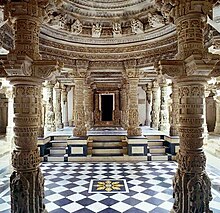
Adishwara temple, Dilwara Temples

Sunset at Mount Abu
Mount Abu town, the only hill station in Rajasthan, is at an elevation of 1,220 m (4,003 ft). It has been a popular retreat from the heat of Rajasthan and neighbouring Gujarat for centuries. The Mount Abu Wildlife Sanctuary was established in 1960 and covers 290 km² of the mountain.
The mountain is home to several Hindu temples, including the Adhar Devi Temple (also known as Arbuda Devi Temple), carved out of solid rock; the Shri Raghunathji Temple; and a shrine and temple to Dattatreya built atop the Guru Shikhar peak and a number of Jain temples including Dilwara Temples, a complex of temples carved of white marblebuilt between the 11th and 13th centuries CE. The oldest of these is the Vimal Vasahi temple, built in 1021 CE by Vimal Shah and dedicated to the first of the Jain Tirthankaras. They include the Achaleswar Mahadev Temple (1412) and the Kantinath Temple (1513). It is the location of the headquarters of the Brahma Kumaris.
The Achalgarh Fort, built in the 14th century by Kumbha of Mewar, is nearby and at its center is the popular visitor attraction of the Nakki Lake. The Toad Rock is on a hill near the lake. Close to the fort is the Achaleshwar Mahadev Temple, a popular Shiva temple.
In Mount Abu, the faith community of Brahma Kumaris has its spiritual headquarters, which are represented by its own account in 110 countries.[9] Every year about 2.5 million visitors are supposed to visit the sprawling campus of that spiritual movement.[10]
While there are hundreds of hotels for tourists, some Dharamshalas can be found for as low as Rs.700 per night. Raghunath Dharamshala at the bank of Nakki Lake is one of those in a spiritual environment.
In summer thousands of people come here. To reach Mount Abu, the nearest approach by road is from Abu Road which is 27 km.
The setting sun scene on Mt Abu is famous among tourist; it was depicted in the movie Qayamat Se Qayamat Tak.[citation needed]


Comments
Post a Comment